
Black Texans seek answers from U.S. Senate candidate James Talarico
September 4, 2026 News
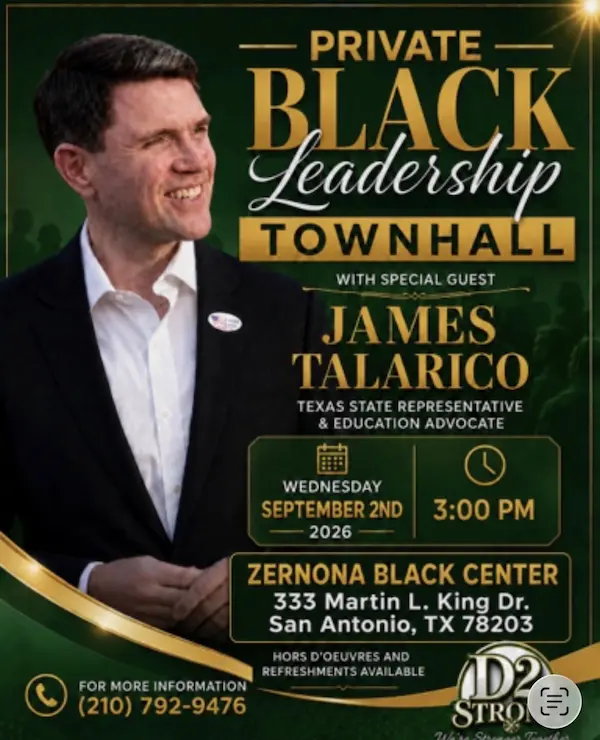
SAN ANTONIO, Texas — Black voters, community leaders, educators, business owners and advocates gathered at the Zernona Black Center in San Antonio for an in-depth community conversation with Democratic U.S. Senate candidate James Talarico, examining what meaningful representation of Black Texans should look like both during the campaign and after Election Day.
The event was facilitated by D2 and State Representative Barbara Gervin-Hawkins, who helped guide a substantive conversation centered on issues directly affecting Black communities in San Antonio and across Texas.
Bexar County Commissioner Tommy Calvert played a significant role in the discussion, posing detailed questions on voting rights, election administration, household affordability, immigration enforcement, Medicare and Social Security, data centers, San Antonio’s military community and the candidate’s plans for engaging Black voters.
The conversation then opened to the community, where audience members raised questions about Black women’s unemployment, protection of federal workers, Black-owned businesses’ access to government contracts, maternal mortality, police accountability, special education, HBCU funding, public education and whether Black Texans would continue to have meaningful access to the candidate after the election.
One message consistently emerged from the room: Black voters do not want to be taken for granted.
Talarico acknowledged that concern directly.
“The Democratic Party for too long has taken the votes of Black Texans for granted,” he said, adding that his campaign intends to approach Black Texans as voters whose support must be earned.
“I am earning votes. I am not assuming anyone’s going to go for me.”
Voting Rights Remain Front and Center
Voting rights were among the most urgent issues discussed.
Calvert raised concerns about changes affecting elections, mail-ballot applications and whether voters fully understand the requirements necessary to successfully complete the voting process.
Talarico said Texas voters already face significant barriers and argued that additional restrictions make voter education and organizing even more important.
He outlined a three-part approach: legal preparation, including working alongside allied organizations and volunteer attorneys; voter education, ensuring voters understand state requirements and application processes; and grassroots organizing, including direct outreach through door knocking, phone calls and text messaging.
He also called for passage of the John Lewis Voting Rights Advancement Act and identified voting-rights reform as part of a broader effort to reform the nation’s political system.
A Direct Message to Black Voters
The conversation turned particularly candid when Calvert asked about the reaction of Black women and other Black voters following the Democratic primary involving Congresswoman Jasmine Crockett.
Talarico rejected the idea that Crockett bears responsibility for convincing her supporters to back him.
“It is not Congresswoman Crockett’s job to win this election. It’s my job,” he said.
He praised Crockett for supporting the Democratic ticket following the primary and said earning Black voters requires more than campaign rhetoric.
That means, he said, addressing issues that disproportionately affect Black Texans, including maternal mortality, voting rights, educational opportunity, federal employment and access to capital.
Talarico also discussed his engagement with historically Black colleges and universities, citing a town hall at Prairie View A&M University and a commencement address at Paul Quinn College.
“If we bet on our HBCUs, if we bet on our young Black Texans, it’s going to benefit all of us in the end,” he said.
Economic Opportunity and Federal Employment
A Black business owner in the audience described the difficulty minority-owned firms face obtaining professional-services contracts and asked how government could ensure large contracting opportunities are structured so smaller businesses have a realistic opportunity to compete.
Talarico said government contracting should provide a level playing field rather than disproportionately benefiting politically connected companies.
He committed to defending programs supporting historically underutilized businesses and expanding avenues for Black entrepreneurs to access capital.
“We know when Black businesses are successful, Black people are successful,” he said. “And when Black people are successful, all Texans are successful.”
An East Side resident raised two closely connected concerns: unemployment among Black women and the future of federal workers.
Talarico argued that recent reductions in the federal workforce have disproportionately affected Black women, describing federal employees as public servants whose work directly affects public safety, communities and the economy.
If elected, he said he would fight to restore federal positions and functions he believes were improperly eliminated.
Black Maternal Health as a Priority
Black maternal health drew significant attention when a community advocate asked how the candidate would confront maternal deaths and complications that disproportionately affect Black women.
Talarico pointed to previous work extending postpartum Medicaid coverage in Texas to one year and called for additional federal action.
His proposals included paid family leave, expanded insurance coverage for doulas and midwives, addressing maternal-care deserts and improving healthcare-provider training to address bias when Black women report pain or other symptoms.
Representation Beyond Election Day
One of the most consequential questions of the conversation focused not on Election Day, but what happens afterward.
A Black woman in the audience asked how Talarico would ensure Black voices continue to influence his decisions if elected.
Talarico acknowledged that representing a state as large and diverse as Texas requires continuous engagement. He said his senior campaign staff is majority-minority and majority-women and pointed to the advisory-committee model he used while serving in the Texas Legislature.
If elected to the Senate, he committed to creating multiple advisory committees, including at least one composed of Black Texans from communities across the state, to provide direct feedback about how policies affect their communities.
“The work of representing Black Texans starts now,” he said.
Household Expenses, Medicare and Senior Care
Addressing the financial pressure families experience from everyday expenses, Talarico pointed to his legislative record and his personal experience with Type 1 diabetes.
He recalled discovering after his diagnosis that his first 30-day supply of insulin would cost $684, an experience he said helped motivate his work on Texas legislation addressing insulin copays.
At the federal level, Talarico said he would focus on the costs of groceries, prescription drugs, utilities and transportation. He also advocated suspending the federal gasoline tax and changing trade policies he believes contribute to higher consumer prices.
“The real fight in this country is not left versus right,” he said. “It’s top versus bottom.”
Invoking the legacy of President Lyndon B. Johnson, whose former Senate seat he is seeking, Talarico pledged to defend Medicare and advocated changing the Social Security payroll-tax structure so higher earners contribute more.
Discussing his grandmother’s Alzheimer’s disease and his family’s experience finding care, he also called for expanding access to affordable, quality elder care.
Data Centers: Water, Energy and Community Impact
Calvert raised concerns about the rapid growth of data centers, focusing on water consumption, electricity demand, housing costs, tax incentives and the ability of communities to influence development decisions.
Talarico said data-center developers should be responsible for their energy demands, responsibly manage and recycle water, obtain meaningful community input and operate without depending on what he characterized as sweetheart tax arrangements.
His position was direct: if a proposed data center cannot meet those expectations, it should not be built.
Military City USA and Veterans
San Antonio’s military community also featured prominently in the discussion.
Calvert asked about the candidate’s commitment to active-duty service members, veterans and military families, as well as San Antonio’s military missions and infrastructure.
Talarico expressed interest in serving on Senate committees focused on health and education as well as the Armed Services Committee.
He pledged to support full funding for the Department of Veterans Affairs, oppose efforts to privatize the VA, expand veterans’ mental-health resources, reduce healthcare wait times and protect benefits for Gold Star families.
He also argued that supporting service members means exercising greater caution when committing American forces to prolonged military conflicts.
Public Education, Special Education and Early Learning
Education remained a recurring theme throughout the conversation.
Audience members raised concerns about students with autism and other disabilities, inadequate special-education resources, school closures, teacher morale and educator compensation.
Talarico, a former public-school teacher, emphasized his support for public education and opposition to private-school vouchers.
When asked to identify a transformative policy he would pursue in Washington, Talarico highlighted universal, high-quality early-childhood education.
He argued that the earliest years of a child’s life are critical to development and that access to quality education should not depend on ZIP code, family income or school district.
“Every single child has a gift to give the world,” he said.
Police Accountability and Public Safety
An audience member who described a troubling personal encounter with the criminal-justice system questioned Talarico about police brutality and accountability.
Talarico pointed to his legislative work following the death of Javier Ambler during an encounter with Williamson County law enforcement.
He argued that adequately supporting law-enforcement officers and demanding accountability for misconduct are not mutually exclusive.
“Public safety can’t just mean public safety for some of us,” he said. “It has to mean public safety for all of us.”
Immigration Enforcement and Civil Liberties
Calvert also questioned Talarico about ICE enforcement and immigration detention, raising broader concerns about civil liberties and government power.
Talarico strongly criticized masked immigration-enforcement operations and said ICE should focus its resources on violent offenders rather than families, children, business owners and longtime community members.
If elected, he said he would support greater Senate oversight and investigations of ICE, including accountability for agency leadership.
Political and Supreme Court Reform
Near the conclusion of the conversation, Talarico argued that progress on healthcare, education, economic opportunity and voting rights will remain difficult without broader political reform.
He called for reducing the influence of large political donors, overturning Citizens United, prohibiting members of Congress from trading individual stocks and establishing national protections against partisan gerrymandering.
The final policy discussion turned to the U.S. Supreme Court.
Talarico supported establishing a binding code of conduct for Supreme Court justices, expressed support for term limits and said the country should consider expansion of the Court.
An Expectation of Accountability
The central message emerging from the San Antonio conversation extended beyond November 3.
Black Texans in the room were not simply asking who should receive their votes. They were asking what representation would look like after those votes are counted.
Who will have a seat at the table? Will Black-owned businesses have meaningful opportunities to compete for government contracts? Will HBCUs receive adequate investment? Will Black mothers receive better healthcare? Will federal workers be protected? Will Black communities have a direct voice in the decisions made in Washington?
Talarico repeatedly said those votes must be earned.
The conversation at the Zernona Black Center demonstrated that Black Texans intend to be active participants in that process—not only at the ballot box, but in shaping the policies, priorities and accountability they expect from those elected to represent them.