The Long Struggle for the Ballot in Texas
February 16, 2026,
The Ballot in Texas Was Never Freely Given
The right to vote in Texas was not gifted.
It was fought for.
It was stripped away.
And it was reclaimed — through courage, litigation, and organized resistance.
This is not distant history.
This is Texas history.
Reconstruction: A Glimpse of Democracy
After the Civil War, the 14th Amendment granted citizenship.
The 15th Amendment protected Black men’s right to vote.
For a brief moment, democracy expanded in Texas. Black men voted. They held office. Federal troops protected polling places. Communities believed the promise of citizenship would endure.
But Texas power structures had other plans.
The promise was real — but it was never secure.
1902: The Poll Tax and the Architecture of Exclusion
When federal protection ended, Texas engineered a new system of suppression.
In 1902, the state imposed a poll tax. You had to pay to vote.
This was not accidental.
It targeted Black Texans.
It targeted poor Texans.
It targeted rural voters.
This was economic disenfranchisement by design.
The message was clear: participation would be conditional.
Exclusion was legalized.
The White Primary and Legal Resistance
The Democratic primary was the only election that mattered in one-party Texas. So when Black voters were excluded from primaries, they were excluded from democracy itself.
Dr. Lawrence A. Nixon of El Paso challenged the white primary system. His cases — Nixon v. Herndon and Nixon v. Condon — struck down discriminatory laws.
Each victory was followed by new tactics to preserve exclusion.
But the resistance did not stop.
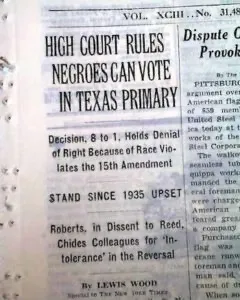
In 1944, Smith v. Allwright finally dismantled the white primary system when the Supreme Court ruled that primaries were part of the electoral process and racial exclusion was unconstitutional.
The system collapsed.
Not because power yielded — but because Black Texans refused to accept silence.
Why This Matters Now
Texas has 254 counties. Democracy here has always required vigilance. Every generation must decide whether it will protect the ballot — or allow it to be weakened.
The history of voting in Texas teaches us three truths:
-
Suppression often wears the mask of policy.
-
Progress is met with pushback.
-
Rights that are not protected can be taken.
The Texas Coalition of Black Democrats understands that organization is not symbolic — it is strategic. Statewide coordination matters. County coalitions matter. Regional engagement matters.
Because history shows us what happens when we are not organized.
The ballot in Texas was never freely given.
It was defended in courtrooms.
It was defended in communities.
It was defended at the polls.
And it must be defended still.